

Sleep and Body Composition: How Poor Sleep Changes Your Fat, Muscle, and Bone
Quick Answer: Sleep is one of the most underestimated factors in body composition. Research shows that consistently sleeping fewer than seven hours per night increases fat storage, accelerates muscle loss, and may weaken bone density over time. A body composition DEXA scan can quantify these changes with clinical precision, giving you a clear picture of how your sleep habits are affecting your fat, lean mass, and skeletal health.
Most people think of body composition as something shaped by diet and exercise alone. Yet a growing body of peer-reviewed evidence points to a third pillar that is just as important: sleep. When you consistently fall short on rest, your body shifts into a hormonal state that favours fat gain, undermines muscle recovery, and disrupts the processes that keep your bones strong.
This guide explains exactly what happens to fat, muscle, and bone when sleep is compromised, what the clinical evidence says, and how a DEXA scan at our Harley Street clinic can reveal changes you might not notice on the scales.
Why Sleep Matters for Body Composition
Sleep is not passive downtime. It is an active metabolic state during which your body regulates a cascade of hormones that directly control how you store fat, repair muscle, and remodel bone.
During deep sleep, the pituitary gland releases the majority of your daily growth hormone (GH). GH stimulates protein synthesis in skeletal muscle, promotes lipolysis (the breakdown of stored fat), and supports osteoblast activity in bone tissue. When sleep is cut short, GH secretion drops significantly, and these restorative processes are curtailed (Dattilo M et al., Medical Hypotheses, 2011).
Sleep also governs the hunger hormones leptin and ghrelin. Leptin signals satiety; ghrelin signals hunger. A landmark study by Spiegel and colleagues at the University of Chicago found that restricting sleep to four hours per night for just two consecutive nights reduced leptin by 18% and increased ghrelin by 28%, leading participants to crave calorie-dense, high-carbohydrate foods (Spiegel K et al., Annals of Internal Medicine, 2004).
Cortisol, the primary stress hormone, also follows a sleep-dependent rhythm. Healthy sleep keeps cortisol low overnight and allows a natural rise in the early morning. Chronic sleep restriction elevates evening cortisol levels, promoting visceral fat deposition and accelerating protein breakdown in muscle (Leproult R, Van Cauter E, JAMA, 2011).
How Sleep Deprivation Increases Fat Storage
The relationship between short sleep and fat gain is one of the most robustly documented findings in sleep science. A meta-analysis by Cappuccio and colleagues, pooling data from over 600,000 adults worldwide, found that individuals sleeping fewer than five hours per night had a 55% higher risk of obesity compared to those sleeping seven to eight hours (Sleep, 2008).
The mechanism goes beyond simply eating more because you are awake longer. Sleep deprivation alters insulin sensitivity, meaning your cells become less efficient at clearing glucose from the blood. The pancreas compensates by producing more insulin, and elevated insulin levels promote fat storage, particularly in the abdominal region.
A controlled trial by Nedeltcheva and colleagues demonstrated this vividly. Participants followed the same calorie-restricted diet but were randomised to either 8.5 hours or 5.5 hours of sleep per night. After two weeks, the sleep-restricted group lost 55% less body fat and 60% more lean mass than the well-rested group, despite eating identical calories (Annals of Internal Medicine, 2010). The implication is striking: poor sleep does not just slow fat loss, it redirects weight loss away from fat and toward muscle.
For anyone tracking their progress with a body composition DEXA scan, this finding underscores why the number on the scales can be misleading. Two people losing the same amount of weight may have very different outcomes underneath, and sleep is one of the variables that determines which tissue is actually being lost.
The Link Between Sleep and Muscle Loss
Muscle tissue is not built in the gym. It is built during recovery, and the most important recovery window is sleep. During slow-wave (deep) sleep, growth hormone pulses trigger muscle protein synthesis, repairing the microdamage caused by resistance training and daily activity.
When sleep is restricted, this repair process is compromised in two ways. First, the total volume of growth hormone released overnight falls, reducing the anabolic stimulus. Second, cortisol levels remain elevated for longer, tipping the balance toward muscle protein breakdown (catabolism) rather than growth (anabolism).
Testosterone, another key anabolic hormone, is also sleep-dependent. Leproult and Van Cauter showed that restricting young healthy men to five hours of sleep per night for one week reduced daytime testosterone levels by 10 to 15%, an effect equivalent to roughly 10 to 15 years of ageing (JAMA, 2011). Lower testosterone impairs the body’s ability to maintain and build lean tissue.
We explored how cortisol specifically drives changes in fat, muscle, and bone in our guide to cortisol and body composition. Sleep deprivation and chronic stress share many of the same hormonal pathways, which is why their effects on body composition overlap so closely.
For individuals who exercise regularly, poor sleep can undermine weeks of training effort. A DEXA scan taken after a period of sleep disruption may reveal a decline in appendicular lean mass (the lean tissue in your arms and legs) even if overall weight has remained stable.
Sleep, Bone Density, and Long-Term Skeletal Health
Bone is living tissue that is constantly being broken down and rebuilt. This remodelling process is regulated by hormones that peak during sleep, including growth hormone, parathyroid hormone (PTH), and sex steroids. When sleep is chronically insufficient, the balance between bone resorption (breakdown) and bone formation shifts toward net loss.
Research by Swanson and colleagues at the University of Colorado found that three weeks of cumulative sleep restriction combined with circadian disruption significantly altered bone turnover markers in healthy adults. Bone formation markers declined while resorption markers remained unchanged, suggesting that the skeleton was losing more bone than it was rebuilding (Journal of Bone and Mineral Research, 2017).
Separately, the Women’s Health Initiative Observational Study reported that women who slept five hours or fewer per night had significantly lower bone mineral density at the hip, spine, and whole body compared to women sleeping seven hours, even after adjusting for age, BMI, and physical activity (Ochs-Balcom HM et al., Journal of Bone and Mineral Research, 2020).
These findings are particularly relevant for postmenopausal women and older adults already at risk of osteoporosis. A bone density DEXA scan can detect early losses in bone mineral density before a fracture occurs, giving clinicians a window to intervene with lifestyle changes, supplementation, or medication.
How a DEXA Scan Reveals Sleep-Related Body Composition Changes
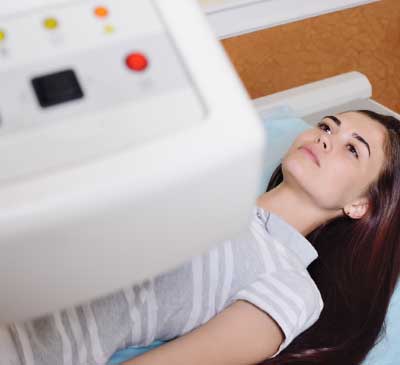
Dual-energy X-ray absorptiometry (DEXA) is the clinical gold standard for measuring body composition. Unlike bathroom scales, bioimpedance devices, or BMI calculations, a DEXA scan separately quantifies three distinct tissue compartments: fat mass, lean mass (including muscle), and bone mineral content. It also maps where these tissues are distributed across your body.
This level of detail makes DEXA uniquely suited to detecting the subtle shifts that poor sleep causes. A person sleeping fewer than six hours per night might maintain a stable weight but quietly accumulate visceral fat around the organs while losing lean tissue in the limbs. Standard weighing would miss this entirely. A DEXA scan would not.
At DEXA London, each scan produces a detailed report showing your total and regional fat mass, lean mass, visceral adipose tissue (VAT) area, bone mineral density T-scores, and appendicular lean mass index (ALMI). Tracking these metrics over time provides an objective record of how lifestyle factors, including sleep, are shaping your body beneath the surface.
If you would like to understand more about the technology behind the scan, you can learn more about how DEXA scanning works on our dedicated information page.
How Much Sleep Do You Actually Need?
The NHS recommends that most adults aim for seven to nine hours of sleep per night. The National Sleep Foundation offers similar guidance, noting that individual needs vary but that consistently sleeping fewer than six hours is associated with measurable health risks.
Sleep quality matters as much as duration. Fragmented sleep, even totalling seven or eight hours, may not deliver the same hormonal benefits as consolidated, uninterrupted rest. Deep sleep (slow-wave sleep) and REM sleep each play distinct roles in physical recovery and metabolic regulation.
Certain populations need to pay especially close attention. Shift workers, new parents, individuals with sleep apnoea, and people managing chronic pain or anxiety disorders are all at elevated risk of cumulative sleep debt. Over months and years, this debt compounds into measurable changes in body composition that a DEXA scan can detect and track.
It is worth noting that oversleeping (consistently more than nine hours) has also been linked to adverse metabolic outcomes in some studies, though the evidence is less consistent than for short sleep. The goal is not to maximise hours in bed but to achieve consistent, restorative sleep within the recommended range.
Practical Steps to Improve Sleep for Better Body Composition
Improving sleep does not require expensive supplements or complicated protocols. The following evidence-based strategies can meaningfully improve both sleep quality and, over time, your body composition outcomes.
Keep a consistent schedule. Going to bed and waking up at the same time every day, including weekends, helps regulate your circadian rhythm. Irregular sleep timing is independently associated with higher body fat percentage and metabolic dysfunction (Huang T et al., Scientific Reports, 2020).
Limit evening light exposure. Blue light from screens suppresses melatonin production, delaying sleep onset. Dimming lights and avoiding screens for 30 to 60 minutes before bed can improve the speed and depth of sleep initiation.
Prioritise protein earlier in the day. Adequate protein intake supports muscle protein synthesis during sleep, but large meals close to bedtime can disrupt sleep architecture. Aim to finish your last substantial meal at least two to three hours before bed.
Manage stress and cortisol. Chronic stress and poor sleep reinforce each other in a cycle that accelerates unfavourable body composition changes. Techniques such as structured breathing, journalling, or cognitive behavioural therapy for insomnia (CBT-I) can break this pattern. The NHS recommends CBT-I as the first-line treatment for chronic insomnia.
Stay physically active. Regular exercise, particularly resistance training, improves sleep quality and supports lean mass retention. However, intense exercise within two hours of bedtime may delay sleep onset for some individuals.
Address underlying sleep disorders. Conditions such as obstructive sleep apnoea (OSA) are common and often undiagnosed. OSA is strongly associated with visceral fat accumulation and metabolic syndrome. If you snore heavily, wake frequently, or feel unrefreshed despite adequate time in bed, speak to your GP about a referral for a sleep assessment.
Weight management next step
If your DEXA results show elevated visceral fat or unfavourable fat-to-lean ratios that persist despite improving your sleep and exercise habits, a supervised weight-loss programme may be worth considering. CutKilo, the sister service to DEXA London, offers doctor-led Mounjaro (tirzepatide) treatment from Dr. Emil Gadimali. Start the CutKilo questionnaire to see if you are suitable.
Frequently Asked Questions
Can poor sleep cause weight gain even if my diet stays the same?
Yes. Sleep deprivation alters insulin sensitivity and shifts hunger hormones in favour of increased calorie intake and fat storage. Studies show that people who sleep fewer than six hours per night are significantly more likely to gain weight over time, independent of dietary intake (Cappuccio FP et al., Sleep, 2008).
How quickly can sleep deprivation affect my body composition?
Measurable hormonal changes occur within days. Spiegel and colleagues documented significant shifts in leptin and ghrelin after just two nights of restricted sleep. Changes in fat and lean mass distribution typically become detectable on a DEXA scan over weeks to months of chronic poor sleep.
Will a DEXA scan show whether poor sleep is affecting my body?
A DEXA scan cannot diagnose a sleep disorder, but it can reveal the downstream effects of chronic sleep deprivation on your body composition. Increased visceral fat, reduced appendicular lean mass, and declining bone mineral density are all patterns consistent with sustained poor sleep.
Does napping make up for lost sleep?
Short naps (20 to 30 minutes) can improve alertness but do not fully compensate for the hormonal and metabolic benefits of a full night of consolidated sleep. Deep sleep and REM sleep, which are critical for growth hormone release and tissue repair, require extended uninterrupted sleep periods.
I sleep eight hours but still feel tired. Could my body composition be affected?
Yes. Sleep quality matters as much as duration. Conditions like obstructive sleep apnoea fragment sleep architecture, reducing time spent in restorative deep sleep even when total hours appear adequate. If you feel chronically unrefreshed, a DEXA scan can help assess whether your body composition reflects this, and a GP referral for a sleep study may be appropriate.
Book Your DEXA Body Composition Scan at Harley Street
If you are concerned about how sleep, stress, or lifestyle factors may be affecting your body composition, a DEXA scan provides the clearest clinical picture available. At DEXA London, located at 86 Harley Street in central London, we offer comprehensive body composition and bone density scans with same-week availability.
Each appointment includes a full DEXA scan and a detailed results consultation. You will receive precise measurements of your fat mass, lean mass, visceral fat, and bone mineral density, along with actionable guidance on what your results mean for your health.
To book your scan or ask a question, call us on 0207 637 8227 or visit our body composition scan page to learn more and schedule your appointment online.
Written by Dr Emil Gadimali