

Visceral Fat DEXA Scan: What Your Results Reveal About Metabolic Health
Quick answer: A DEXA scan is the most accurate clinical method for measuring visceral fat, the metabolically active fat stored around your internal organs. Unlike BMI or waist measurements, DEXA quantifies your visceral adipose tissue (VAT) in grams, giving you and your doctor a precise baseline for tracking metabolic risk and treatment progress.
Most people think of body fat as the soft layer sitting just beneath the skin. That subcutaneous fat is visible and easy to measure with callipers or a tape measure. But it is not the type that poses the greatest threat to your long-term health.
Visceral fat sits deeper, wrapped around organs like the liver, pancreas, and intestines. It is invisible from the outside, which means you can carry dangerously high levels without knowing it. A body composition DEXA scan is the gold standard for revealing exactly how much visceral fat you have, where it sits, and whether your levels fall within a healthy range.
In this guide, we explain what visceral fat is, why it matters for metabolic health, how a DEXA scan measures it, and what your results mean in practical terms.
What Is Visceral Fat?
Your body stores fat in two main compartments. Subcutaneous fat lies directly beneath the skin and accounts for roughly 80 to 90 percent of total body fat in most adults. It acts as insulation and energy storage, and while excess subcutaneous fat contributes to overall weight, it is relatively benign from a metabolic standpoint.
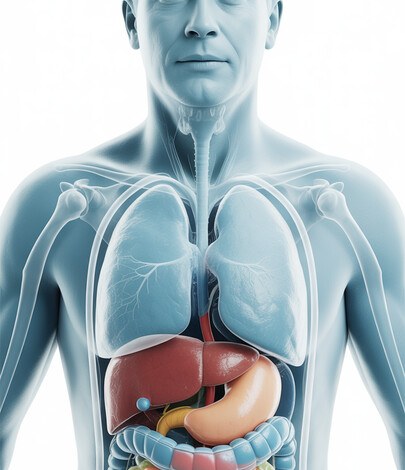
Visceral adipose tissue (VAT) is different. It occupies the abdominal cavity, cushioning and surrounding the liver, stomach, kidneys, and intestines. Unlike subcutaneous fat, visceral fat is metabolically active. It releases inflammatory cytokines, free fatty acids, and hormones that directly influence insulin sensitivity, blood pressure, and lipid metabolism.
Research published in The Lancet Diabetes & Endocrinology has shown that visceral fat volume is a stronger independent predictor of cardiometabolic disease than total body fat or BMI alone. This is why two people at the same weight can have very different health profiles: the distribution of fat matters as much as the amount.
A person with a healthy BMI can still carry excess visceral fat, a pattern sometimes called “thin outside, fat inside” or TOFI. Without imaging, this risk is invisible.
Why Is Visceral Fat Dangerous?
The NHS identifies excess visceral fat as a significant risk factor for several serious conditions. Because visceral fat drains directly into the portal vein feeding the liver, it has an outsized effect on metabolic processes compared to fat stored elsewhere in the body.
Elevated visceral fat is strongly associated with:
- Type 2 diabetes: visceral fat impairs insulin signalling and contributes to insulin resistance, a key driver of type 2 diabetes (NHS, Diabetes UK).
- Cardiovascular disease: the inflammatory markers released by visceral fat promote arterial plaque formation, raising the risk of heart attack and stroke (British Heart Foundation).
- Non-alcoholic fatty liver disease (NAFLD): excess VAT is closely linked to fat accumulation in the liver, which can progress to fibrosis and cirrhosis.
- Certain cancers: the World Cancer Research Fund has identified abdominal obesity, driven largely by visceral fat, as a risk factor for colorectal, pancreatic, and post-menopausal breast cancer.
- Metabolic syndrome: a cluster of conditions including high blood pressure, elevated blood sugar, abnormal cholesterol, and increased waist circumference, often underpinned by excess visceral fat.
What makes visceral fat particularly concerning is that it can accumulate silently. You may look lean, feel well, and still be carrying enough visceral fat to significantly elevate your metabolic risk. This is precisely why objective measurement matters.
How Does a DEXA Scan Measure Visceral Fat?
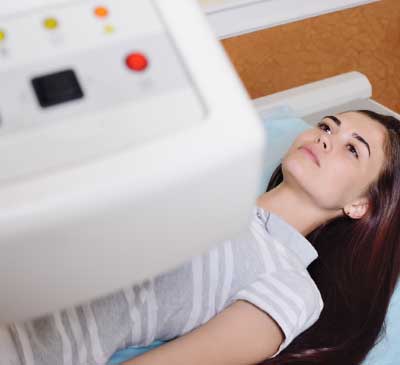
DEXA (dual-energy X-ray absorptiometry) works by passing two low-dose X-ray beams through the body at different energy levels. The way each beam is attenuated by bone, lean tissue, and fat allows the scanner to map your body composition with precision down to individual body regions.
For visceral fat specifically, modern DEXA software uses the CoreScan or equivalent algorithm to isolate the android (abdominal) region and separate visceral fat from the subcutaneous fat overlying it. The result is a direct measurement of visceral adipose tissue reported as:
- VAT mass in grams
- VAT volume in cubic centimetres
- VAT area in square centimetres (estimated cross-sectional area, comparable to a CT slice)
This level of detail is not available from simpler methods. Waist circumference gives a rough proxy but cannot distinguish visceral from subcutaneous fat. Bioelectrical impedance (BIA) scales estimate visceral fat using algorithms that are less accurate, particularly in people with unusual body compositions. CT and MRI can measure visceral fat precisely but involve higher radiation doses (CT) or significantly higher cost (MRI), making them impractical for routine monitoring.
A DEXA scan takes approximately 10 to 15 minutes, involves minimal radiation (less than a day of natural background exposure according to Public Health England guidelines), and requires no special preparation. You can learn more about how DEXA scanning works on our dedicated page.
Understanding Your Visceral Fat DEXA Results
After your scan, you will receive a detailed report showing your visceral fat measurements alongside your overall body composition. Here is how to interpret the key figures.
VAT mass (grams): this is the total weight of visceral fat in your abdominal cavity. As a general clinical guide, a VAT mass below approximately 500 grams is considered low risk. Between 500 and 1,000 grams indicates moderate risk and warrants monitoring. Above 1,000 grams is associated with significantly elevated cardiometabolic risk, and clinical intervention is typically recommended.
VAT area (cm²): this estimates the cross-sectional area of visceral fat at the L4-L5 vertebral level, the standard reference point used in clinical research. A VAT area below 100 cm² is generally considered healthy. Above 100 cm² is the threshold most frequently cited in peer-reviewed literature as indicating elevated metabolic risk (Despres, International Journal of Obesity).
VAT volume (cm³): a volumetric estimate that complements the mass and area figures. Your clinician may use this alongside other markers to assess your overall metabolic profile.
These numbers are most useful when tracked over time. A single scan gives you a baseline; repeat scans at three to six-month intervals reveal whether lifestyle changes, medication, or other interventions are actually reducing your visceral fat stores.
Your DEXA report will also show your body fat percentage ranges and what they mean for your health, regional fat distribution, and lean mass data, giving you the complete picture rather than a single number.
Who Should Get a Visceral Fat DEXA Scan?
While anyone can benefit from understanding their body composition, a visceral fat DEXA scan is particularly valuable for people in the following groups:
- Adults over 40: visceral fat tends to increase with age, even when overall weight remains stable. Hormonal changes during perimenopause and andropause accelerate this shift.
- People with a family history of type 2 diabetes or cardiovascular disease: genetic predisposition can increase visceral fat accumulation regardless of lifestyle.
- Those with a normal BMI but elevated waist circumference: the TOFI pattern (thin outside, fat inside) is surprisingly common and only detectable through imaging.
- Patients taking GLP-1 receptor agonists: medications like Mounjaro (tirzepatide), Ozempic (semaglutide), and Wegovy are highly effective at reducing visceral fat, but tracking that reduction requires accurate measurement. A DEXA scan before and during treatment shows exactly how much visceral fat you are losing, not just overall weight.
- People recovering from metabolic syndrome or fatty liver disease: serial DEXA scans can confirm whether visceral fat is responding to treatment.
- Athletes and fitness enthusiasts: understanding the ratio of visceral to subcutaneous fat helps optimise training and nutrition strategies.
If you are unsure whether a visceral fat scan is right for you, our clinical team at DEXA London can advise during your booking consultation.
How to Reduce Visceral Fat Based on Your DEXA Results
If your DEXA scan reveals elevated visceral fat, the good news is that visceral fat responds well to intervention. In fact, research consistently shows that visceral fat is often the first fat compartment to reduce with lifestyle changes, even before you notice visible changes in subcutaneous fat.
Exercise: the evidence favours a combination of moderate-intensity aerobic exercise (such as brisk walking, cycling, or swimming for 150 minutes per week, per NHS guidelines) and resistance training. A meta-analysis published in Obesity Reviews found that aerobic exercise reduces visceral fat independently of dietary changes, and adding resistance training amplifies the effect by preserving lean mass.
Nutrition: reducing refined carbohydrates, added sugars, and alcohol has a disproportionately large effect on visceral fat compared to subcutaneous fat. The Mediterranean dietary pattern, rich in vegetables, legumes, whole grains, fish, and olive oil, has been shown to reduce VAT even without calorie restriction (Estruch et al., The New England Journal of Medicine).
Sleep and stress management: chronic sleep deprivation and elevated cortisol are both independently associated with visceral fat accumulation. Prioritising seven to nine hours of sleep and managing stress through evidence-based approaches can support visceral fat reduction.
Medical intervention: for patients with clinically significant visceral fat levels, supervised medical treatment may be appropriate. GLP-1 and dual GIP/GLP-1 receptor agonists such as Mounjaro (tirzepatide) have demonstrated substantial reductions in visceral fat in clinical trials, often exceeding what lifestyle changes alone can achieve.
Weight management next step
If your DEXA results point to elevated visceral fat or metabolic risk, a supervised weight-loss programme may be worth considering. CutKilo, the sister service to DEXA London, offers doctor-led Mounjaro treatment from Dr. Emil Gadimali. Start the CutKilo questionnaire to see if you are suitable.
Follow-up DEXA scans at three to six-month intervals are the most reliable way to confirm that your visceral fat is responding to whichever approach you take. Tracking VAT mass over time removes guesswork and keeps your intervention evidence-based.
Frequently Asked Questions
Can you have high visceral fat with a normal BMI?
Yes. This is known as the TOFI (thin outside, fat inside) phenotype. Research suggests that up to 30 percent of people classified as normal weight by BMI carry excess visceral fat. A DEXA scan is one of the only ways to identify this hidden risk.
How often should I get a visceral fat DEXA scan?
For most people, an initial baseline scan followed by a repeat scan at three to six months is a good starting point. If you are actively trying to reduce visceral fat through lifestyle changes or medication, scanning every three months gives you the most actionable data.
Is a DEXA scan safe?
Yes. The radiation dose from a DEXA scan is extremely low, roughly equivalent to one to two days of natural background radiation. Public Health England classifies it as a negligible-dose procedure.
What is the difference between visceral fat and subcutaneous fat on a DEXA report?
Subcutaneous fat is the fat stored directly beneath your skin. Visceral fat is stored deeper, around your internal organs. Your DEXA report separates these two compartments in the android (abdominal) region, so you can see exactly how much of your abdominal fat is visceral.
Can visceral fat be reduced without losing weight?
Yes. Exercise, particularly aerobic activity combined with resistance training, can reduce visceral fat even when total body weight stays the same. This is because you may be gaining lean muscle while losing visceral fat, a change that only a body composition scan like DEXA can detect.
Does waist circumference accurately reflect visceral fat levels?
Waist circumference is a useful screening tool, but it cannot distinguish between visceral and subcutaneous abdominal fat. Two people with the same waist measurement can have very different visceral fat levels. DEXA provides the precision that waist measurements cannot.
Book Your Visceral Fat DEXA Scan at Harley Street
At DEXA London, we offer comprehensive body composition scans that include precise visceral fat measurement at our Harley Street clinic. Every scan is reviewed by a qualified clinician, and your results are explained in full so you understand exactly what your numbers mean and what steps to take next.
Whether you are investigating metabolic risk, tracking progress on a weight management programme, or simply want a clear picture of your internal health, a bone density DEXA scan or body composition DEXA scan gives you the clinical-grade data you need.
To book your visceral fat DEXA scan, call us on 0207 637 8227 or use the online booking form on our website. Same-week appointments are often available.
Written by Dr Emil Gadimali, Clinical Director at DEXA London.