


Body Fat Percentage: What’s Healthy, What Looks Good, and Why a DEXA Scan Is the Gold Standard
If you’ve ever searched “what is a healthy body fat percentage” and ended up more confused than when you started, you’re not alone. The numbers vary wildly depending on the source — and most methods people use to measure body fat are surprisingly inaccurate.
This guide cuts through the noise. It explains what healthy body fat actually looks like for men and women, what different percentages mean for your appearance and health, and why a DEXA scan remains the most precise tool available for measuring and tracking body composition.
Why Body Fat Percentage Matters More Than Your Weight
Your weight is almost meaningless in isolation. Two people can be identical in height and weight yet look — and feel — completely different. That’s because body composition is what actually determines how you look, how you perform, and how healthy you are.
Body fat percentage shapes your energy levels, hormone balance, metabolic rate, cardiovascular risk, and physical appearance. It’s the metric that clinicians, sports scientists, and elite athletes rely on — not the number on the scale.
Healthy Body Fat Percentage Ranges for Men
| Category | Body Fat % |
|---|---|
| Essential fat | 2–5% |
| Athlete | 6–13% |
| Fitness / Lean | 14–17% |
| Average | 18–24% |
| Overfat | 25–31% |
| Obese | 32%+ |
Based on ACSM clinical and sports-science reference ranges.
Healthy Body Fat Percentage Ranges for Women
| Category | Body Fat % |
|---|---|
| Essential fat | 10–13% |
| Athlete | 14–20% |
| Fitness / Lean | 21–24% |
| Average | 25–31% |
| Overfat | 32–39% |
| Obese | 40%+ |
Women naturally carry more essential fat than men due to hormonal and reproductive physiology — lower isn’t always better.
Based on ACSM clinical and sports-science reference ranges.
What Different Body Fat Levels Actually Look Like
Understanding the numbers is one thing. Understanding what they feel and look like in practice is another.
For men, the lean-but-healthy sweet spot sits around 14–17%. At this level, muscle definition is visible, energy is high, and hormonal health is preserved. Drop below 10% and most men outside of competitive sport will experience fatigue, mood disruption, poor sleep, and suppressed testosterone.
For women, the equivalent range is roughly 21–26%. This is where most women look toned and feel their best — strong, healthy, and sustainably lean. Going significantly below 20% without elite athletic conditioning can lead to hormonal disruption, irregular cycles, poor bone density, and low energy.
The idea that lower body fat is always better is one of the most common — and most damaging — myths in fitness. There is an optimal zone. Your goal is to find yours.
How to Accurately Measure Body Fat Percentage
This is where most people go wrong. The method you use to measure body fat matters enormously.
| Method | Accuracy |
|---|---|
| Bathroom body-fat scales | Poor |
| Skinfold calipers | Poor to moderate |
| Tape-measure formulas | Poor |
| BodPod (air displacement) | Moderate |
| DEXA scan | Highest available |
Bathroom scales that claim to measure body fat use bioelectrical impedance — a signal that’s highly sensitive to hydration, food intake, time of day, and skin temperature. They’re consistent enough to be broadly indicative, but far too imprecise to act on.
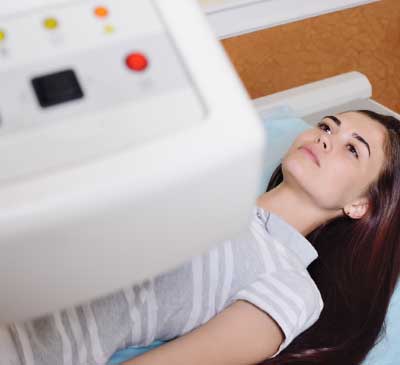
DEXA (Dual-Energy X-ray Absorptiometry) works differently. It uses two low-dose X-ray beams to differentiate between fat tissue, lean muscle mass, and bone — across your entire body, region by region. The result is a detailed, clinically precise picture of exactly what you’re made of.
What a DEXA Body Composition Scan Actually Tells You
A DEXA scan goes far beyond a single body fat percentage number. In a single 10-minute scan, you receive:
- Total body fat percentage — precise to within 1–2%
- Regional fat distribution — arms, legs, trunk, android (belly) and gynoid (hip/thigh) zones
- Visceral fat measurement — the metabolically dangerous fat stored around your organs, which is invisible from the outside and not detectable by scales
- Lean muscle mass — total and by body region, including left-right symmetry
- Bone mineral density — a critical health marker often overlooked in body composition assessments
Visceral fat is particularly important. It’s strongly associated with cardiovascular disease, type 2 diabetes, and metabolic syndrome — yet it cannot be estimated from weight, BMI, or consumer devices. DEXA is currently the most accessible and accurate non-invasive method for quantifying it.
The Real Power of DEXA: Tracking Change Over Time
A single scan tells you where you are. Repeat scans tell you whether your approach is actually working — and that distinction is where DEXA becomes genuinely transformative.
Weight alone is a poor guide to progress. Someone who loses 5 kg might be thrilled — but if 2 kg of that loss came from muscle rather than fat, they’ve actually moved in the wrong direction metabolically. DEXA catches that. It allows you to course-correct early, protect muscle during a cut, and confirm that your training and nutrition strategy is doing what you think it is.
Recommended scan intervals:
- Every 3 months — for active fat loss, body recomposition, or GLP-1 / weight-loss medication programmes (Mounjaro, Ozempic, Wegovy)
- Every 6 months — for muscle-building phases
- Every 12 months — for general health monitoring
Because DEXA uses extremely low-dose radiation — less than you’d receive on a short-haul flight — it’s safe to repeat throughout the year without concern.
Who Should Get a DEXA Body Composition Scan?
A DEXA scan is valuable for anyone who wants accurate data rather than guesswork. That includes:
- Men working towards a leaner or more athletic physique
- Women seeking a healthy, sustainable level of body fat
- Anyone on a fat-loss programme wanting to confirm they’re losing fat, not muscle
- Strength athletes and gym-goers tracking muscle development
- People using GLP-1 medications who need to monitor body composition changes closely
- Anyone who wants a reliable, science-based starting point for their health or fitness goals
Why DEXA Is the Gold Standard — Not Marketing Language
The term “gold standard” gets used loosely in health and fitness. In the case of DEXA for body composition, it’s clinically earned.
DEXA is the reference method used in peer-reviewed research on body composition. It’s used by the NHS for bone density assessment, by professional sports organisations for athlete monitoring, and by obesity clinicians for metabolic risk stratification. No consumer device, formula, or fitness tracker comes close to its precision or the depth of information it provides.
If you want to make informed decisions about your health, physique, or training — real decisions, based on real data — a DEXA scan is the logical starting point.
Book Your DEXA Body Composition Scan in London
DEXA London is based at 86 Harley Street and operated by 3Beam, a CQC-registered diagnostic centre with GMC and HCPC-registered clinical staff.
Scans are fast, comfortable, and low-radiation. Results are reviewed by a clinician and explained clearly, so you leave understanding exactly what your numbers mean and what to do with them.
Book your DEXA scan today and get the clearest picture of your body composition available anywhere in London.