
DEXA T-Score vs Z-Score: What They Mean for Your Bone Health
A DEXA bone density scan produces two main scores: your T-score and your Z-score. Both compare your bone mineral density to a reference group, but they answer different clinical questions, and confusing them can lead to the wrong conclusion about your bone health.
This guide explains what each score means, when doctors rely on one versus the other, and what to do if your result falls outside the healthy range. Written by the clinical team at DEXA London on Harley Street.
Quick answer
- T-score compares your bone density to a healthy young adult of the same sex. It is the main score used to diagnose osteopenia and osteoporosis in post-menopausal women and men over 50.
- Z-score compares your bone density to people of your own age, sex, and sometimes ethnicity. It is the main score used for pre-menopausal women, men under 50, and children.
- Both scores are expressed as standard deviations. A score of zero is the reference average; a score of minus 1 is one standard deviation below that average.
- A low T-score suggests fracture risk. A low Z-score suggests something beyond normal ageing may be driving bone loss and usually prompts a search for a secondary cause.
What Are T-Scores and Z-Scores?
A T-score and a Z-score are both standard deviation scores. They tell you how far your measured bone mineral density sits from a reference average, in units of standard deviation.
The difference is which reference group your result is compared against.
T-score reference group: healthy young adults of the same sex, at the age when peak bone mass is reached (around age 30). A T-score of zero means your bone density matches that peak reference. A T-score of minus 1 means you are one standard deviation below that peak, and so on.
Z-score reference group: people of the same age, sex, and sometimes the same ethnicity as you. A Z-score of zero means your bone density matches the average for your demographic. A Z-score of minus 1 means you are one standard deviation below that average.
Both scores are calculated automatically from your DEXA bone density scan and appear on your report alongside the raw bone mineral density value in grams per square centimetre.
How a DEXA Scan Produces These Scores
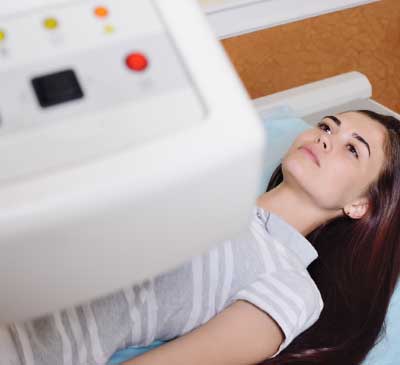
A DEXA scan uses two low-dose X-ray beams at different energy levels to measure how much radiation is absorbed by bone versus soft tissue. The difference between the two readings gives bone mineral density in grams per square centimetre at each scanned site.
The World Health Organization criteria use measurements at the lumbar spine (L1 to L4), the total hip, and the femoral neck as the primary sites for diagnostic scoring. Forearm scanning is used when hip or spine results cannot be obtained reliably, for example in severe spinal degeneration or bilateral hip replacements.
Once the raw bone mineral density is recorded, the scanner software compares your value to stored reference databases. The main reference used in the UK is the NHANES III young-adult database, which is why most T-scores you will see in clinical practice are derived from that dataset for the femoral neck and total hip.
The output is then printed on your report as a number of standard deviations above or below the reference mean. That is your T-score. The same calculation performed against the age-matched reference gives your Z-score.
T-Score Ranges: Normal, Osteopenia, and Osteoporosis
The World Health Organization has defined cut-points for T-scores that underpin the clinical diagnosis of low bone density and osteoporosis in post-menopausal women and men aged 50 and over.
Normal: T-score of minus 1.0 or higher. Your bone density is within one standard deviation of the healthy young-adult reference and sits in the expected range.
Osteopenia (low bone mass): T-score between minus 1.0 and minus 2.5. Bone density is below the reference range but not low enough to meet the osteoporosis threshold. Osteopenia is not a disease, but it is a flag that fracture risk is elevated compared with people in the normal range.
Osteoporosis: T-score of minus 2.5 or lower at the spine, total hip, or femoral neck. At this threshold, the risk of fragility fracture is substantially elevated, and treatment is usually recommended alongside lifestyle measures.
Severe (established) osteoporosis: T-score of minus 2.5 or lower plus a history of one or more fragility fractures. This combination is used to describe the most clinically significant group.
These categories come from the World Health Organization and are the basis for UK guidance published by the Royal Osteoporosis Society and the National Osteoporosis Guideline Group.
Z-Score Ranges: When Your Result Is Age-Adjusted
Z-scores use a different cut-point system because the reference group already accounts for age-related bone loss.
Within expected range for age: Z-score greater than minus 2.0. Your bone density is broadly in line with what is expected for someone of your age and sex.
Below expected range for age: Z-score of minus 2.0 or lower. Your bone density is meaningfully lower than the age-matched reference, and secondary causes of bone loss should be investigated.
The Z-score is not used to diagnose osteoporosis in the same way the T-score is. Its purpose is different. A very low Z-score in someone in their 30s or 40s is a signal that their bone loss cannot be explained by normal ageing, and something else may be contributing: an endocrine disorder, coeliac disease, long-term steroid use, low body weight, eating disorders, or certain medications, among others.
Because of that, a low Z-score typically prompts a referral for blood tests and, depending on those results, onward specialist review.
When to Use T-Score vs Z-Score
The choice between T-score and Z-score is driven by age, sex, and menopausal status.
Post-menopausal women and men aged 50 and over are assessed using the T-score. This is the group the WHO diagnostic criteria were designed for, and it is where fracture-risk tools such as FRAX are calibrated to work.
Pre-menopausal women, men under 50, and children and adolescents are assessed using the Z-score. In these groups, comparing bone density to a young-adult peak is misleading. A 25-year-old woman with a T-score of minus 1.2 is not osteopenic in any clinically useful sense if her Z-score is plus 0.1, because her bone density is normal for her age.
The International Society for Clinical Densitometry recommends that Z-scores should be used, rather than T-scores, for these younger groups, and that the terms osteopenia and osteoporosis should not be applied to them based on DEXA scores alone.
In everyday practice, both scores usually appear on the report regardless of which one is clinically relevant. The skill is in reading the one that applies to you.
What to Do if Your T-Score Shows Osteopenia
A T-score between minus 1.0 and minus 2.5 places you in the osteopenia range. This is not osteoporosis, but it is a reason to act rather than wait.
The first step is a fracture-risk assessment. In the UK, this is usually done using the FRAX tool, which combines your DEXA result with clinical factors (age, sex, previous fracture, parental hip fracture, smoking, alcohol intake, glucocorticoid use, rheumatoid arthritis, secondary osteoporosis) to estimate your 10-year probability of a major osteoporotic fracture and of hip fracture specifically.
Depending on that FRAX output, your GP or specialist will decide whether lifestyle measures are enough or whether drug treatment is warranted at this stage.
Lifestyle measures worth addressing regardless of treatment decisions:
Resistance training and impact exercise. Loading bone is the most reliable non-pharmacological stimulus to slow or reverse bone loss. The National Osteoporosis Guideline Group supports regular weight-bearing and resistance exercise adapted to the person.
Adequate calcium and vitamin D. UK guidance recommends total calcium intake of around 700 to 1200 mg per day (from food where possible) and vitamin D supplementation especially between October and March, when sunlight exposure alone is insufficient at UK latitudes.
Review of medications. Long-term oral glucocorticoids, some anti-epileptic drugs, certain cancer treatments, and long-term proton pump inhibitor use can accelerate bone loss. A medication review with your GP is worthwhile if you have a low T-score.
Repeat DEXA scanning is usually recommended every 2 to 3 years in this group, depending on baseline result and whether treatment has been started.
What to Do if Your Z-Score Is Low
A Z-score of minus 2.0 or lower in a younger adult is unusual and prompts a search for secondary causes of bone loss. Finding and treating the underlying cause often matters more than prescribing bone-sparing drugs.
A standard work-up typically includes:
Blood tests: calcium, phosphate, vitamin D, thyroid function, parathyroid hormone, full blood count, liver function, kidney function, coeliac screen, and sometimes testosterone in men or oestrogen and FSH in women.
24-hour urine collection: urinary calcium can indicate hypercalciuria, and urinary free cortisol is sometimes requested if Cushing syndrome is suspected.
Specialist referral: to an endocrinologist, rheumatologist, or metabolic bone physician depending on the suspected cause.
Once a cause is identified, treatment is directed at that cause first. Bone-sparing medications are considered on a case-by-case basis in pre-menopausal women and younger men, because fracture-risk evidence in these groups is less developed than in older adults.
If the work-up is negative and lifestyle factors are optimised, repeat scanning in 1 to 2 years will show whether bone density is stabilising or continuing to fall.
Frequently Asked Questions
If my T-score is normal but my Z-score is low, should I worry?
It depends on how low. A Z-score below minus 2.0 is considered below the expected range for age and is generally investigated regardless of the T-score, because it suggests something is accelerating bone loss beyond normal ageing.
Can my T-score improve?
Yes. With treatment, lifestyle measures, or resolution of a secondary cause, T-scores can rise. Bone mineral density changes slowly, so meaningful change is usually seen over 1 to 3 years rather than months.
Which score is used to decide treatment?
In post-menopausal women and men over 50, the T-score is combined with fracture-risk tools such as FRAX to guide treatment. In younger adults, decisions are based on the Z-score together with the underlying cause of bone loss.
Are T-scores and Z-scores the same at every scan site?
No. Bone density at the spine, hip, and femoral neck can differ, and your report shows a separate T-score and Z-score for each site. The lowest valid score is typically used for diagnosis.
Does a DEXA scan hurt?
No. A DEXA scan is painless, takes around 10 to 20 minutes, and uses a very low dose of radiation, less than a single transatlantic flight.
Book a Bone Density DEXA Scan on Harley Street
If you want a clear picture of your bone health, DEXA London offers same-week bone density scans on Harley Street, reported by our clinical team and explained in plain English.
Your report will include both T-scores and Z-scores at the lumbar spine, total hip, and femoral neck, along with a written interpretation and, where appropriate, a FRAX 10-year fracture-risk calculation.
Call 0207 637 8227 or book online to arrange your scan.
Reviewed by Dr Emil Gadimali, MBBS, Clinical Director, DEXA London.